
Manual Recording
To start manual recording, go to a required task page and click the Record action. Set the desired record duration and press the Manual recording button. Now, as the recording is started, you can see the recording progress in the list below. You may abort the process by clicking the stop action. Once the recording is finished, you may download the record archive in the required format, just click the corresponding icon in the Actions column.
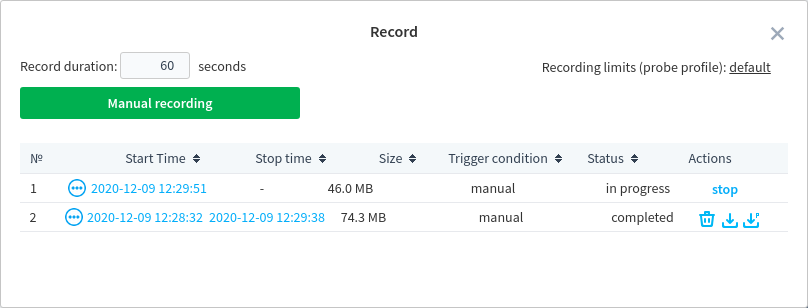
The Record window also displays the following information: recording start and stop time, record size and its status, trigger condition.
The Status column may display the following record states:
in progress — the stream is currently being recorded;
completed — the probe has completed recording;
- aborted — the probe failed to complete recording. The following error codes are possible:
100 — an unknown reason;
101 — the task has been stopped;
102 — insufficient disk space;
103 — recording is prohibited for this source type;
104 — the task crashed, the recording was stopped;
105 — the probe crashed, the recording was stopped;
110 - 119 — the server initiates recording stopping.
blocked — the record is currently downloaded and cannot be deleted.
The Actions column contains three tools to manage records:
 — download a Pcap record. Only for IPTV streaming (UDP/RTP) and SRT stream sniffing;
 — download a conventional record (its type depends on a stream protocol);
 — delete a record.
Some system limitations affect the recording process. To set the limits, click the probe profile name in the top right corner. The pre-buffering and recording duration settings are not applied to manual recording.
Pcap Recording
In order to work with Pcap recordings, note that:
Pcap recordings are supported by IPTV broadcasting (UDP/RTP protocols) and SRT streams while in the sniffing mode;
Downloading Pcap records is disabled by default for security reasons (the probe may create Pcap records, but they cannot be downloaded from the browser). To download a Pcap record, stop the probe or service and open the probe configuration file, then set
truevalue for the"allowDownloadPcapDump"parameter. Save changes and start the probe.In order for a Pcap recording to work correctly, make sure to launch the probe with elevated privileges:
For Windows — install the NPcap library and launch the probe as an administrator,
For Linux — launch the probe as a superuser
sudo ./streamMonitor.
The probe captures network packets’ data and records it to a file in real time. Pcap data can be recorded both in the automatic—when an error state is detected—and manual recording modes. Once the recording is finished, you may download the recorded file. The record file includes a detailed description of a triggered event (in the JSON format) and a Pcap dump file which contains all network protocol headers used for stream delivery as well as timestamps of probe-captured data.
During SRT broadcast sniffing, the probe records the entire packet exchange between all peers into a Pcap dump in accordance with the specified DST/SRC rule. A dump like that can be very helpful for finding out SRT broadcast-related issues.
If the probe fails to analyze a stream, the exact copy of network traffic will be reflected in the Pcap recording for repeated analysis later. To browse Pcap files, use Wireshark or similar software designed for monitoring and analyzing network traffic that’s compatible with the libpcap format.
To download Pcap data, use the action.